

I have been building links for years, across over 50 websites and totaling thousands of links.
I have worked in just about every niche you can imagine, and there is one thing that never fails to amaze me – the sheer amount of links that SUCK.
There is a big disconnect between SEOs who build links on a regular basis, and marketing managers at brands who know they need links but don’t have the time to actually build them or check if the links they are paying for are decent quality.
So, if you’re hiring a link builder or want to check the quality of existing links, this is the guide you need.
The Culprits: Link Lists & Marketplaces
Firstly, let’s actually understand why a lot of links simply suck.
The main issue is that many link builders rely on lists or link marketplaces, where websites are listed and openly sell links to anyone who is willing to pay.
There are countless examples of these marketplaces if you simply Google it, and you’re very likely to come across huge link lists during outreach as well.
These marketplaces mostly list websites that are selling multiple links per day, and a lot of these sites are built specifically with this goal in mind.
Enter the link farm.
The ‘Trick’ Link Farms Use
A link farm is a website designed to sell links.
The owners of these sites know how to make a site’s metrics look good on Ahrefs or Semrush – if you look at a surface level, you might see some decent traffic and DR/DA – but this doesn’t tell the whole story.
The truth is that it isn’t difficult to make a website look like it has a lot of traffic on Ahrefs/Semrush, and there are tricks to inflate DR/DA as well.
For example, you can get a site to rank somewhere in the top 10 to 15 places for a very high volume, low difficulty keyword in India (one of our examples later in the article will show exactly this) and on the surface this will inflate a site’s metrics on a tool like Ahrefs – but is ranking in position 10 for a random keyword in India really telling the whole story?
Similarly, you can easily inflate DR by spamming links across dedicated networks of sites, but this doesn’t mean a site will rank well or pass value on with a link.
Are All Marketplace Links Bad?
I would be lying if I said that all websites found on link marketplaces are bad, it’s just that a LOT of them are.
Link marketplaces are packed full of the same link farms that you’ll see on every other list, and these sites tend not to offer much value from an SEO perspective.
The question becomes, then, how are you supposed to tell which links are good and which suck?
How To Know If A Link Is Junk
Here are a few steps you can follow to quickly find out whether a backlink is worth it or not.
1. Check The Actual Website
The first thing you should do is actually click on the website and look around.
‘Why would I do this?’
Well, we already established that surface-level metrics on an SEO tool are not going to tell the whole story, and it’s usually a lot easier to visually test the site and browse to see if it’s legit or not.
You should be able to tell right away if the website is legit, or if it is built solely to sell links.
When browsing the site, keep these things in mind:
- Does the website look niche relevant to your/your client’s site?
- Are they producing genuine content, or is all of the content clearly paid for?
- Does the website have an actual service or brand? Think software, consulting, online courses, etc.
- Does some of the content cover shady topics? Think casino or adult content, for example.
You’ll start to get a gut feeling as you browse around as to whether the site is genuine or not.
This is only the first step, though, as you can’t trust your gut feeling if you don’t have a lot of experience vetting websites for links.
This is where checking the actual metrics comes into play.
2. Check The Metrics
Once you’ve actually explored the website a little bit, plug the URL into Ahrefs or Semrush.
These SEO tools allow you to see how much traffic the website is getting, how many links it has, and what keywords it ranks for.
The most important things to check are:
- Monthly traffic – The absolute minimum should be 1k per month, ideally higher.
- Traffic location – US/Can/UK traffic is the most popular, but it can vary depending on where the project.
- Keywords ranked – Check whether the site ranks for real keywords or just junk keywords to inflate the traffic. Bonus points here for relevant keywords to the niche of your actual website.
- Domain Rating/Authority – Does the site have real backlinks?
- Traffic history – Has the traffic increased overnight? The best traffic curves are those that are consistent over a long period of time.
- Outbound Links vs Referring Domains – There isn’t an exact science here, but we’re looking for a healthy amount of backlinks vs outbound links – if a site has very few backlinks itself, but has linked out to lots of other sites, it could be a red flag.
Basically, don’t just look at the monthly traffic and domain authority numbers – check where the traffic is coming from, what keywords the site ranks for, how long it’s been around, and whether the content is relevant to your site.
3. Check The Anchor Text
The last thing to keep in mind is the anchor text that has been used.
Exact match anchors should be used in minimal amounts – typically 15-30% depending on the competition. Aside from that, partial match and non-descript anchors should make up the rest.
So, check multiple links to see the strategy that is being used. If you want to rank for ‘best dog food’ and all the links have an anchor of ‘best dog food’ you are setting yourself up to get penalized.
From here, you can get as technical as you like, and there is also an art to choosing the right type of anchor text and target pages when you are building links.
2 Examples of Links That Look Great…But Actually SUCK
Theory is great and all, but it’s much easier to understand when you start to look at actual domains that sell links.
So, let’s have a look at two websites.
For these examples, I will list the URL, estimated monthly traffic, and DR from Ahrefs. On the surface level, you may think that these links look good; however, I will explain in each case why this is not the case and explain my thought process for vetting the links.
Example 1 – sbnewsroom.com – DR 40 & 11.6k monthly traffic
This is a great example of how a website can look great on the surface, even the design and layout look professional, and the metrics are decent.
There are a few instant red flags, though:
- The content being published is clearly ALL paid guest posts. You only have to open up a few recent posts to see what is happening.
- The traffic history is very unstable.
- The main country of traffic is India, followed by the Philippines.
- The top pages rank for very odd keywords, to say the least.
So, this is a textbook example of a link farm that is built to ‘look’ the part – the traffic is good, the domain rating is good, and the site looks professional.
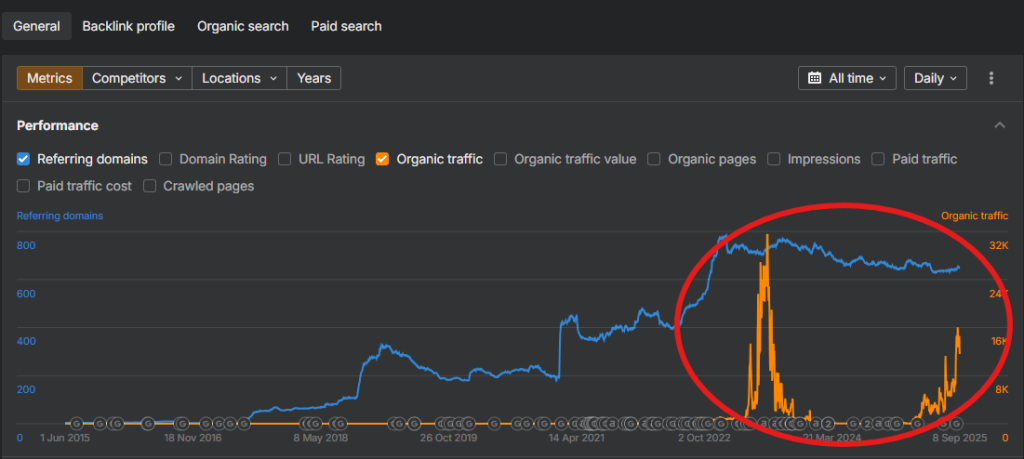
Interesting traffic history (Not always a bad thing)
Under the hood, though, it’s clear that a link from this site would be completely useless.
Ranking keywords are complete spam – A common tactic to inflate traffic
Example 2 – tourandtravelblog.com – DR 35 & 2.2k monthly traffic
Ok, let’s take a look at another example in the tourism niche.
This one, again, looks pretty good at a quick glance – the metrics are ok, and the website looks well-built and professional.
However, a quick glance at recent blog posts shows that they are mostly, if not entirely, paid posts. The traffic history is also very alarming, and again, the top keyword is not relevant to the site.
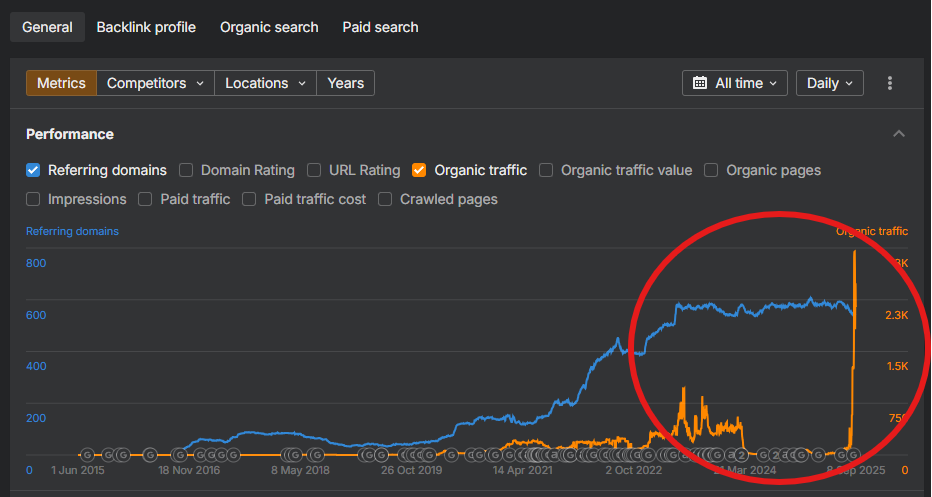
Traffic has only recently picked up
The top keyword is ‘traveltweaks com’ which has 20k volume. This is a common tactic used to inflate traffic, and it’s more than likely that the site actually receives 0 clicks for this keyword, as it is not relevant.
So, again, this is a site that is receiving close to 0 relevant clicks, and a guest post here would not be effective at all.
How To Build Great Links
Before I jump into the steps, I highly recommend checking our article on why backlinks are the easiest way to rank in AI right now. This will help to frame the rest of the article and give you some context as to why building links with the goal of ranking in AI should be a priority for every SEO in 2025.
To put it simply, building links with AI in mind means that the quality of link placements is instantly much higher – this means more traffic, and more benefit for your organic SEO efforts.
So, here’s how to build great links that will support your AI and organic traffic.
Monitor Your AI Citations & Build A List Of Target Keywords
The first step is to monitor your AI presence if you aren’t already, and compare this to your ideal target keywords that you want to rank for.
There will be lots of overlap here – ideally you are being cited for your top keywords. This is highly likely if you already rank well on Google.
Once you have this list, you can then look at what sources are being cited that you want to be included in.
For example, if you’re in a software niche, it’s very likely that there will be listicles that review the best software, or articles that tell users how to solve a problem using a similar or the same type of software that you offer.
You can then shortlist these as ideal targets, and reach out to them.
Conduct Real Outreach To Secure Genuine Placements
Yep, we’re going to be doing actual outreach here and not just relying on websites we already know sell links.
The idea here is to introduce your product or service, and explain why it should be featured in the content. You will almost always have to pay a fee for this to happen, but you will be surprised at the quality of links you can build if you just put in the effort.
Publish With The Goal Of Being Cited In AI
Outside of direct outreach, you can also leverage other sites that might not be directly cited (or may be cited for similar terms), but have enough authority and traffic in the niche to be cited if you were to publish a guest post on them.
This may sound confusing at first, but it actually isn’t – the hardest part of this process is ensuring the article itself actually ranks and gets traction on Google and AI engines.
Here’s a quick rundown of how this works:
- Identify quality sites that accept guest posts in your niche. Remember that we’re looking to get content published on these sites that actually rank for the target keyword of the article.
- Combine your keyword research to identify a keyword you can target with your guest post that will rank on Google (this bit requires SEO expertise).
- Publish the content and wait for it to rank in Google and be cited in AI.
If successful, the content you publish will not only rank for relevant keywords for your own website, but it will also be cited in AI and generate leads both through this citation and organic traffic on Google that refers users to your site.
Digital PR
Lastly, digital PR should always be part of your link building strategy if you want to stay relevant in AI.
The reason for this is simple – digital PR links are the best way to build high DR links that mention your brand, and these are the types of mentions that AI loves.
Digital PR can be done in many ways, but as a baseline you should be signed up to platforms like Qwoted and respond to journalists who ask for expert sources on stories that are relevant to your niche.
This way, you can get featured as an expert in high DR, trusted media sites to help support your link building efforts and AI visibility.
A Quick Recap
Here’s a quick recap:
- A lot of the links you’ll find on lists suck, and these are the lists that a lot of link builder rely on.
- If you don’t keep a close eye on link quality, your link profile can deteriorate quickly.
- Always check your links using the guidelines set out in this article, and build links with AI citations in mind.


