


At Spyndle, we believe earning placements on relevant sites is the most effective way to gain visibility in AI.
In this guide, we’re going to take a look at Outreach.io – an outreach AI revenue workflow platform – to see how they dominate AI results for the search term ‘Best Sales Engagement Platforms’ and how outreach plays a pivotal role.
We’ll also explain how you can take this playbook and apply it to your own B2B SaaS.
How Outreach Impacts AI Visibility
When we say ‘outreach’, we are referring to the process of reaching out to other websites to build relationships and ultimately get your SaaS featured in their content.
The ultimate goal here is to get your SaaS featured on as many niche-relevant, highly cited websites as possible.
The reason for this?
AI loves to pull information from trusted sources, especially for queries like ‘What is the best tool for X?’ or, in this case, ‘Best Sales Engagement Platforms’.
When you search a query like this using AI, a lot of the sources used will be listicles from authoritative software (or other niche-relevant) websites. You’ll see exactly what I mean in the real example we get into shortly.
Improving visibility in these articles, or publishing your own, can impact the results and get your SaaS featured within days.
It’s a lot easier to understand how this works with an actual example, so let’s take a look at Outreach.io and how they achieved this.
Current AI Visibility for ‘Best Sales Engagement Platforms’
In order to see how Outreach.io performs for this term in AI, we used a tool called RankScale.
RankScale allows you to add custom search terms and check visibility across multiple AIs in custom locations. For this test, we ran the search term ‘Best Sales Engagement Platforms’ across the following in the United States:
- Google AI Mode
- AI Overview
- Perplexity
- ChatGPT
- Gemini
The output of this was pretty clear-cut. Outreach.io features prominently across all AIs tested, averaging the top positions across all, with high visibility and brand sentiment:

In order to understand more about how this works, let’s take a look at the results for ChatGPT, including the actual output and the sources used:

As you can see, Outreach.io is featured as the number one option for ‘Best Sales Engagement Platforms’ in ChatGPT, ranking above larger companies like HubSpot and Apollo.
When we look into the sources, the list is completely dominated by listicles:

And even more…

ChatGPT relies heavily on credible listicles to use as sources for this search term, as well as many other B2B SaaS comparisons or ‘best of’ type queries or prompts.
Outreach.io is featured prominently across many of these listicles, which helps to reinforce them as the best option in the view of ChatGPT.
What The Brand Mentions Actually Look Like
Let’s take a quick look at what these brand mentions actually look like in the listicles that ChatGPT uses as sources.
Firstly, the listicles from crm.org that positions Outreach.io as the ‘best sales engagement platform overall’:

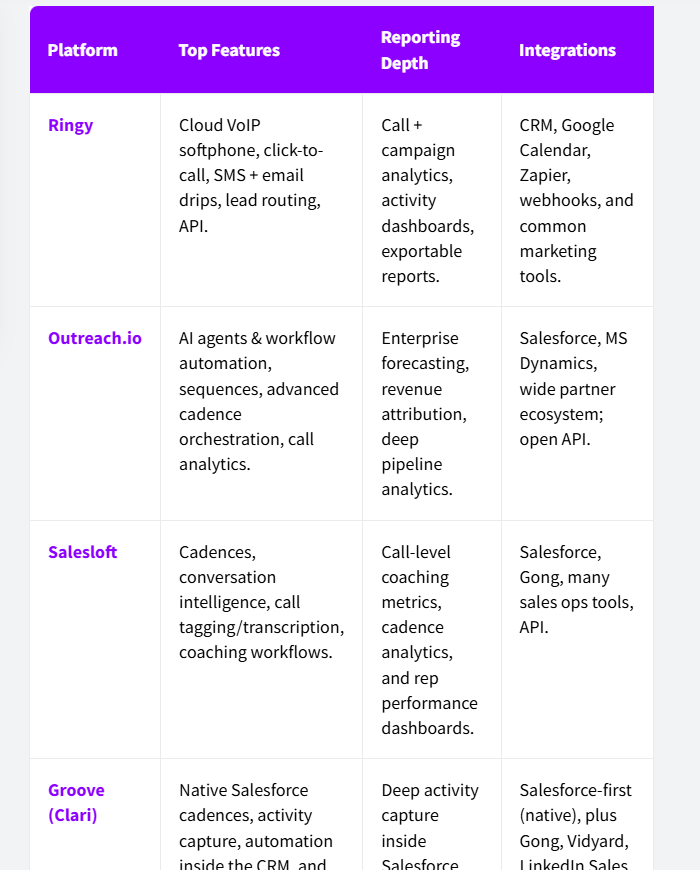
And next, this listicle from Ringy, which actually positions itself as the best option (more on this shortly).
Interestingly enough, Outreach.io is still featured as the second-best option, which is another great mention for them to have:
Outreach.io is also featured on Ringover’s listicle, which is also self-promotional:

And another final example, Outreach.io is featured on this listicle by Podium:

You probably get the idea by now.
Outreach.io is featured across most of the listicles used as sources for this term in ChatGPT, which helps them position as the best option.
A Note On Self-Publishing Listicles
As you can see in the sources and also in the Ringy example above (and others), many brands now self-publish these articles to position themselves as the best option.
This is a classic SEO strategy, and can work quite well. The main problem here is competition – most brands do this, and it can be hard to outrank behemoth sites with high DR and traffic.
This is where being featured in multiple listicles becomes important – the more brand mentions you have across multiple listicles, the higher your chances of being cited highly in AI.
Outreach.io is featured prominently across many of the listicles that are used as sources, rather than just their own self-published listicle. In fact, there isn’t even an article from Outreach.io featured in the sources at all.
This helps position them as the market leader and sends authoritative signals to ChatGPT, which collects data from multiple sources.
What About Related Terms?
When a user chats to AI, it’s very unlikely that they would search ‘Best Sales Engagement Platforms‘ on their own – what is more realistic is a conversation prompt that asks for the best sales engagement platforms.
Luckily, many of these listicles are cited for different variations of the main keyword, as they are contextually relevant. This means that a brand mention on a listicle will lead to multiple citations, not just the one for the main term.
Tracking this is a whole different question, but a good metric is your overall level of referral traffic from AI, as well as booked demos.
How To Replicate This For Your Brand
Now, you’re probably wondering how to implement something like this for your own SaaS business.
There are a few steps to this process, but the general approach looks like this:
Research Phase
The first step is to research what terms matter the most to your business.
We have an in-depth article on this specifically here, which covers using your own customers’ words directly to generate sales from ChatGPT (and other AIs).
You can combine this approach with keyword research, as well as in-house data on which pages perform best and which keywords they rank for or bid on via ads.
The output of this should be a list of keywords, prompts, and conversational queries that are relevant to your brand and likely to generate sales.
It’s likely that for B2B SaaS brands, ‘best of’ type keywords will feature heavily in this list.
Outreach + Communication
Once you have your list in place, you need to find websites that are:
- Niche-relevant to your queries. The ideal website should rank for terms in the same niche, where possible.
- High quality and authoritative.
- Highly cited in AI engines.
- Have other solid SEO metrics.
These sites ideally need to be open to cooperating and forming a relationship with your brand; otherwise, you won’t be able to get your product featured in an article.
This part is also crucial, because you need the content that you publish to rank on Google, ideally highly.
Different AIs pull data in different ways. For example, Perplexity relies highly on the Google top 10 and mimics the results it finds there. ChatGPT does a search and then looks for the most trusted/licensed domains. Google AI Overviews rely on the search index.
Getting your listicle or article to rank highly on Google on a third-party website means that it will continue to be used as a source for AI over a longer period of time.
It also means it will hold up better over time as more people catch on to this tactic and use lower-quality sites to (potentially) replicate it.
Content Production (Where Needed)
After a bit of back-and-forth, you may need to write an article for the website (targeting one of your pre-planned keywords), or the website may have an editor who can handle that.
Another option is being featured in an existing listicle, known as a link insertion or niche edit.
If you do need to write content, make sure it is well-written and follows SEO best practices. Again, it’s always a safer bet to get the article ranking in Google to see better AI results, and you get the added benefit of organic traffic via Google as well as the do-follow link in the article to your SaaS.
Monitoring Results
Once your content is published, use an AI tracking tool like RankScale to see how your brand is cited for the term over time.
At Spyndle, we typically see results for clients within 1 to 2 weeks, depending on the query. There are a few other things that play into this, though:
- Competition – Some niches are extremely competitive, where listicles are published on some of the highest-tier websites possible (like Forbes, for example). In these cases, we can still get clients cited, but the results tend to be more volatile, and it becomes harder to sustain the position.
- Recency – Another big factor is recency. AI loves recent content, so it’s important to publish new listicles and content aimed at AI citations as often as you can.
How Much Traffic Would This Generate?
If you’re wondering how much traffic a term like this would actually generate, you are not alone.
I wrote an article on this exact topic a few months ago, and I highly recommend reading it – you can find it here for reference.
The general idea is to estimate based on your current AI search traffic (if you rank for relevant keywords) or use a rough guess based on Ahrefs search volume.
AI referral traffic does convert extremely well, though, and it is important to control your brand’s narrative and compete with other sites in your niche.
Wrapping It Up
Outreach.io is doing an exceptional job at AI visibility, and a lot of this is due to their brand’s visibility in high-authority listicles.
We see this all the time at Spyndle, and we help a lot of clients outrank their competition using this very tactic. If you’re still unsure about this tactic, try publishing a high-quality listicle on a relevant website and see how much it gets cited – you might just be surprised.
