


Traditional SEO forgave bad positioning and messaging.
You could get away with speaking to “everyone” with your content. Your product category could change from article to article. Your differentiator or unique POV could be non-existent.
And yet, an SEO-optimized website could still generate traffic and demos.
That’s because search engine algorithms basically work like matching and ranking directories. If your website had a strong backlink profile, high domain authority, and quality content, you could rank well in Google search even if your core positioning and messaging was entirely generic.
AI search doesn’t work like that.
They act as consensus engines and synthesizers. What does that mean? To provide a direct answer to a user, the AI must understand exactly what your product is, who your ideal customer profile is, and what specific problem you solve.
In other words, your positioning must be crystal clear. Or the LLMs will work against you.
This article dives deeper into why positioning and messaging is essential for AI search success — even more so than traditional SEO.
And if you ever need help with your positioning, give my step-by-step guide to clarifying youtube messaging a try. It’s helped more than 100 SaaS startups.
But first, let’s get on the same page about what positioning really means.
What is positioning? Think ‘context setting’
Positioning expert April Dunford’s definition is still the cleanest one: positioning defines how your product is a leader at delivering something a well-defined set of customers cares a lot about.
In B2B tech, your positioning can be captured by answering four questions:
1) What is your product? (category)
2) Who is it for? (your persona or ICP)
3) What does it replace? (usually an ineffective tool or process)
4) What makes it better? (your differentiator)
Simply defining number one can make a huge difference in how your audience thinks about you. Dunford explains that buyers evaluate products relative to the category they think the product belongs in, so choosing the right category plays a huge role in determining the success of your product. Put another way: it is the frame that tells the market how to understand you.
For example: My previous client LivePlan positioned its product as “business planning software.” But based on its capabilities, it could also have been positioned as “financial forecasting” or “small business analytics.” The trick is to pick a product that emphasizes your strengths and plays down your weaknesses. But that’s just part of the positioning equation.
Your positioning determines which product category (ie. CRM) you attach yourself to, but also which buyer you prioritize, which alternatives you contrast against, and which differentiators deserve airtime. Messaging is just that strategy turned into words. And your brand, in practice, is the repeated public memory of that messaging. To learn more, check out April Dunford’s book Obviously Awesome.
Why positioning is critically important for AI search (even more than traditional SEO)
With AI search, you’re not just being found: you’re being framed (in a non-criminal way :). Here’s what I mean:
In old-school SEO, a page could rank for “best sales engagement software” even if the company’s actual positioning was muddy or covered multiple product categories. The search engine was matching terms, links, page quality signals, and overall relevance.
In AI search, the engine is often generating a market summary. It is not just asking, “Should I show this page?” It is asking, “How should I describe this company inside the answer?” Google’s documentation on AI features illustrates this: its systems expand the query across related searches and gather supporting pages from a wider set of sources than classic search.
So if your positioning is unclear, the AI model has three bad options.
1) It can mis-frame you (and call you something you’re not)
2) It can flatten you into a generic category label (like “email tool”)
3) Or it can leave you out of the answer entirely.
How AI gets confused by fuzzy positioning
Here’s a more technical explanation: Modern search and AI systems rely heavily on entities.
An entity is a clearly defined “thing” in the real world that a machine can recognize and disambiguate. Examples include companies, products, people, places, or concepts. Instead of treating text as just strings of keywords, search engines try to understand the entities those words refer to and the relationships between them.
Once you understand entities, the idea of entity strength becomes clearer.
Entity strength is simply how confidently a machine can answer questions like:
• What company is this?
• What category does it belong to?
• What problem is it known for?
• Which audience is it associated with?
• Do multiple trusted sources describe it the same way?
In other words, entity strength is positioning translated into machine-readable signals.
If your company consistently says something like:
“We are X category software for Y audience solving Z problem”
And third-party sources repeat that framing, your entity becomes stronger. The model sees a stable pattern across the web and can retrieve and describe you with confidence.
But if your positioning shifts constantly — one page says “AI automation platform,” another says “customer engagement system,” and a partner directory calls you “CRM add-on software” — the entity becomes fuzzier in the eyes of LLMs.
When that happens, the model has less confidence in when to retrieve your brand and how to describe it inside an answer.
Specificity wins. And can give small brands an edge
Specificity gives little guys an advantage.
Answer engines are usually trying to solve a specific problem described in whatever prompt is served up to them. When someone asks a question about a workflow, a tool, or a business problem, the model looks for vendors it can confidently connect to that situation. This touches on what are often referred to as Category Entry Points.
That means products with clear, narrow positioning are easier for the system to retrieve and recommend. The model does not have to guess what the product does or when it should appear.
Broad positioning works against you here. When a company describes itself as a general platform or an “all-in-one solution,” it weakens the signal that tells the model which problems the product is actually meant to solve. The product becomes harder to classify and harder to retrieve.
Large brands (with those big, juicy marketing budgets) do have an advantage. They generate far more mentions across the web and accumulate associations with many categories and workflows. That broader footprint gives them more opportunities to appear across different prompts.
But specificity still matters.
This is why smaller or more specialized SaaS companies often show up disproportionately in AI answers.
The more clearly your company is associated with a specific category or use case, the easier it is for the model to recognize when you belong in the answer. Over time those associations compound. The product that is easiest to connect to the problem is often the one that gets recommended.
Example: How Descript wins with tight messaging
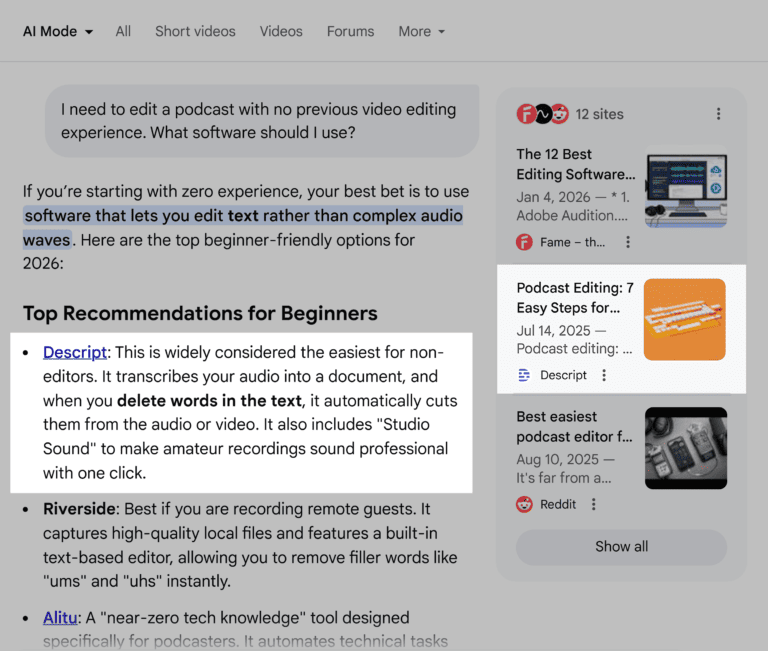
Descript isn’t the biggest company in video editing. At around 200 employees, it’s competing with giants like Adobe and CapCut.
Yet its AI visibility is surprisingly strong, as this case study by Backlinko explains:
Part of that success comes from clear positioning and messaging.
For years, Descript has been strongly associated with one use case: editing podcasts and spoken audio. That shows up across their product pages, tutorials, and blog content. They’re not trying to sound like a giant all-purpose creative platform. They speak very clearly to people who want to edit podcasts without a steep learning curve.
This isn’t accidental. Descript is clear about who it’s for, and their content reflects that focus.
That matters in AI search because LLMs do not simply reward the pages that rank highest in Google. They look for the sources that most directly match the question being asked. So even pages with modest traditional rankings can still get pulled into AI answers if the fit is strong enough.
Because Descript’s content stays tightly focused on one audience, one use case, and one core problem, it maps cleanly to those queries. When someone asks about podcast editing tools, Descript is an obvious fit.
High-ACV? Here’s your opportunity
If you sell B2B software with an high annual contract value, AI search might be the most valuable traffic channel. As long as your brand is positioned well.
Two reasons for this:
1) AI search lets you target much more specific problem-level queries.
In traditional SEO, people use maybe 3-5 words to describe what they are looking for. Maybe: “best AI software for lead generation.” But in AI tools, they write longer, more detailed prompts with real context, real constraints, and real pain points.
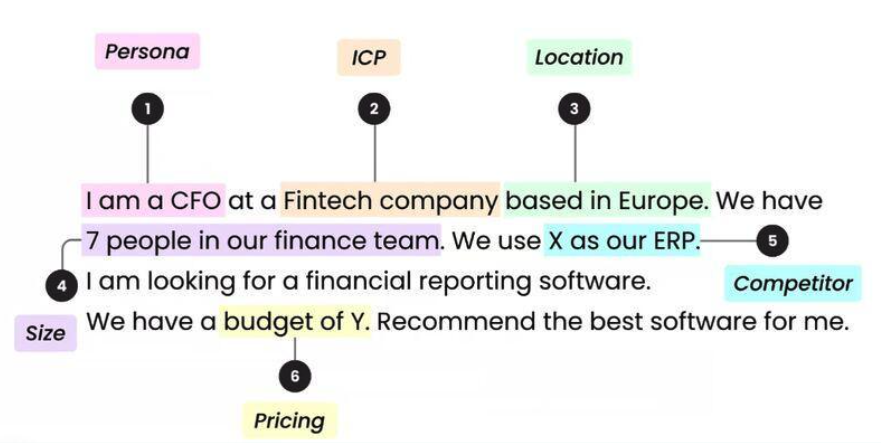
That creates an opening for B2B SaaS companies that know exactly which problems they solve best. And if you use VOC data from sales calls, interviews or reviews you can uncover the exact language your best-fit buyers use when those problems are top of mind.
2) Those long-tail AI queries tend to convert better.
The volume is lower, no question. But the traffic is usually far more qualified (and much more likely to convert) because it is tied to a specific situation, workflow, or pain point. That makes each visit worth more than a click from a Google search. If your ACV is above $10k, even a small number of highly relevant visits can be meaningful. It all depends on how much a qualified demo is worth to you.
AI search is a game of positioning
Traditional SEO gave companies more room to get away with vague positioning.
AI search doesn’t.
These systems need to understand exactly what you are, who you’re for, and when you should be recommended. If your positioning is fuzzy, your AI visibility work gets weaker no matter how much content, PR, or brand mention volume you throw at it.
That’s why the KPI has changed.
It’s not just “do we show up?” It’s “are we included in the right answers, for the right use case, with the right framing?”
And that only happens when your positioning is clear and your messaging is consistent across the web. If different sources describe you in different ways, the model gets a blurry picture and gives a blurry answer.
In AI search, clarity is not a nice-to-have. It’s the thing that makes inclusion possible.