

Informational content has always had its place in organic search, but that place is shifting with the ever-growing popularity of AI.
In this article, we’ll cover a few things:
- How informational content and its role in search has changed
- What this means for brands
- How to know whether it is worth it to invest in informational content
Let’s dive right in.
How Things Have Changed
Before diving into the state of informational content at the present day, I want to take a quick look at the last few years of SEO to see how and why the benefit of this type of content is not the same as it once was.
It was only a few years ago when many websites followed an informational, long tail keyword strategy that looked like this:
- Target long tail keywords with high volume and low difficulty
- Publish hundreds (or thousands) of articles on the same topic, becoming an authority in the space
- Generate thousands of pageviews via Google organic traffic and monetize with display ads, affiliate programs, newsletter, etc
This tactic was incredibly effective for a long time, and there were literally thousands of authority blogs in just about every niche you could imagine.
However, things were about to change in 2023 when Google directly went after these types of websites.
Enter The (Un)Helpful Content Updates
The downfall of this strategy began in September 2023, when Google released the helpful content update.
This update directly targeted sites that were following this type of strategy, and started to reward ‘brands’ much more heavily in SERPs.
This meant that websites like ecommerce stores, or web apps, were generally positively impacted by the update, whereas blog websites that published informational content were hit quite hard.
If you want proof of what I mean, check out the analytics snapshot below from a blog I own – this blog followed the long tail keyword strategy and was hit by the September core update.

Following this update, there were many others that continued to hit these types of sites, like the November 2023 core update and the March 2024 core update.
The signal from Google was VERY clear – unless your website was a large brand with lots of backlinks and authority (or a real business), publishing lots of informational content to rank for long tail queries was not going to be as rewarding as before.
Controversy
The main controversy with these updates was that a lot of very high-quality websites were impacted.
Let’s look at an example – retrododo.com.
This site covers Reto Gaming news and reviews to an incredibly high level (see for yourself), but lost an absurd amount of traffic following the updates:
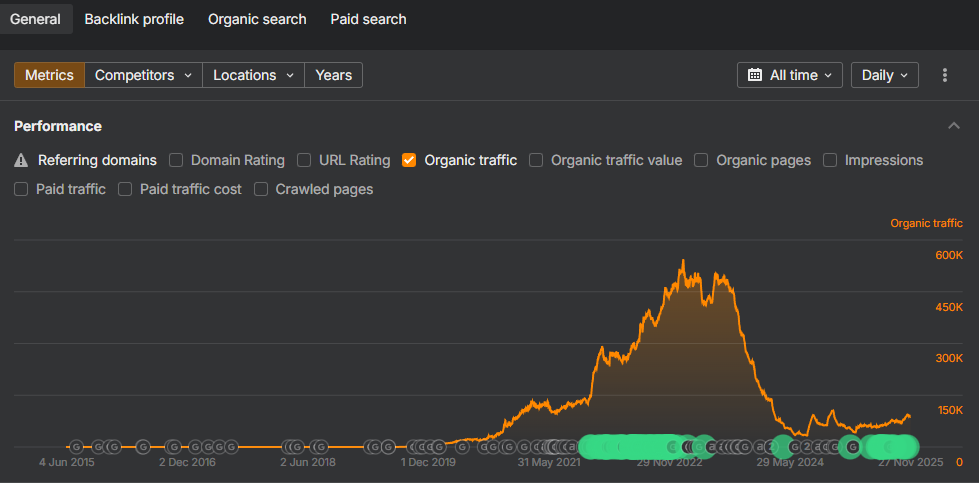
Google began favoring sites that did not follow this type of strategy, even if their actual content quality was much lower.
For example, ecommerce websites in the pet niche could publish low-quality, informational blog posts that would outrank vet-reviewed content from established blogs that had been around for years.
There are obviously exceptions to this rule on both sides, but things have never really been the same since these updates rolled out.
The Case For Informational Content In The Era Of AI
Fast forward to 2025, and informational content has been even further devalued thanks to the rise of AI, both from Google AI overviews, which now dominate most SERPs, and AI engines like ChatGPT and Perplexity.
It is estimated that around 60% of all searches on Google result in 0 clicks, and the usage of AI is only growing.
So, what does this actually mean for informational content?
All hope isn’t lost.
Best Practice For SEO
It’s still considered best practice to publish informational content, particularly for terms that are relevant to your main service offering.
While the traffic numbers might be lower than before, it is still useful to build topical authority in your niche and educate users who either visit your site via the SERPs or directly.
Also, blog posts are great for building internal links to your money pages, and there is still real benefit in doing this. You can then target these pages with backlinks as well, but that’s beyond the scope of this article.
Brand Recognition
Informational content can help boost your brand recognition.
Even if a user is less likely to click through to a blog post than ever before, if they see your brand associated with the information across several queries, it can help to position you as one of the leaders in the space.
There isn’t an exact science to this, or a way to directly measure the impact, but more exposure for relevant terms in your niche is always a good thing.
AI Citations
Similarly to the above, informational content does tend to get cited by AI quite frequently.
AI citations are a new benchmark in SEO, and something that all websites should aim to increase, even if the direct impact is harder to measure.
Organic Link Building
A very underrated benefit of informational content – especially pieces that focus on statistics or studies – is that they are excellent at naturally obtaining links.
The great thing about this is that you can target specific queries that are more likely to attract natural links (based on the current URLs that rank and their link profiles).
Link building can get expensive fast, so being able to obtain links naturally is very, very underrated.
Cover Unique Topics
This one is also pretty underrated, but informational content can be used to cover topics that your competitors simply haven’t.
By this, I mean topics that are so unique to your brand or service that there is little to no search volume for them.
This type of content won’t generate much traffic, but it will help users learn more about your brand and learn information they can’t find elsewhere.
The Case Against Informational Content In The Era Of AI
Let’s take a look at the case against informational content, an argument that is growing every day.
0 Click Searches
The simple fact is that the number of 0-click searches is only increasing, and this is especially true for informational content.
Even if you get cited in the AI Overview, there is a slim chance of someone clicking through to your website.
Take the search ‘how often should i water my cactus’ for example:

Like millions of other informational search terms, the AI overview dominates the top of the SERP and does not entice users to click through to any website in particular.
Return On Informational Content
Measuring the return on informational content is very difficult, especially if you are not in a display-ad type of niche.
Informational content for niches like SAAS, Ecommerce, and local businesses can be tracked, but the conversion rate tends to be very, very small.
This means that, while great for building a brand and getting exposure, informational content is rarely solely responsible for conversions and driving a solid return on investment.
What Approach Should You Take?
The approach you should take depends on your business and your business’s goals.
Informational content is still great at raising brand awareness, attracting organic links, and educating your ideal audience. There is still a lot of traffic out there to claim as well, even with the diminishing returns due to AI and Google updates.
So, if you have the capacity and cash flow to invest in informational content, it is still a good idea. The only caveat is that you need to target queries that you can rank for; otherwise, the benefit (purely from SEO) is minimal.
If budget is a concern, focusing on bottom-of-funnel terms makes more sense:
- Ecommerce stores should focus on their main product collections
- SAAS companies should focus on their main product pages, review pages, and comparison pages
- Local businesses should focus on local, lead-generation keywords
Once you have these bases covered, informational content can support your overall brand-building efforts.

