

AIO, AEO, GEO, LLMO… The list goes on.
It’s no secret that traffic from ChatGPT, Perplexity, Gemini, and the rest is increasing rapidly, and this trend looks set to continue.
This has led to an influx of content around how to get cited in LLMs from SEOs across the world – optimizing your content in specific ways, allowing LLMs to crawl your site more easily, including recent data and statistics, following a clear question-and-answer format – there are literally hundreds of tips floating around.
This is all great, but what if there was an easier way to get cited?
Why You Should Optimize For AI Citations
Firstly, let’s look at why you should actually optimize for AI citations.
Don’t get me wrong, I am still a firm believer that 99% of traditional SEO is beneficial for AI citations – if you rank well in Google, you will also rank decently well in AI (for now, at least).
The simple fact is that AI tools like ChatGPT, Perplexity, and Google Overviews are being used more and more, and this shouldn’t be ignored.
AI Overviews had over 1.5 billion users per month in 2025, OpenAI is hoping to reach 1 billion users by the end of this year, and may have already – and that isn’t even mentioning things like Google’s new AI mode.
Will traditional search still exist in 5 years? Of course.
The question is how much traffic will be captured by AI in one way or the other, versus the traditional SERPs we have come to know and love.
Plus, as you will learn through reading this guide, optimizing for AI does not mean throwing away traditional SEO – in fact, our most preferred method for reliable AI citations is directly beneficial for ‘traditional’ SEO as well.
This means you can get the best of both worlds without tunnel-visioning on AI citations above all else.
User Quality From AI VS Traditional Search
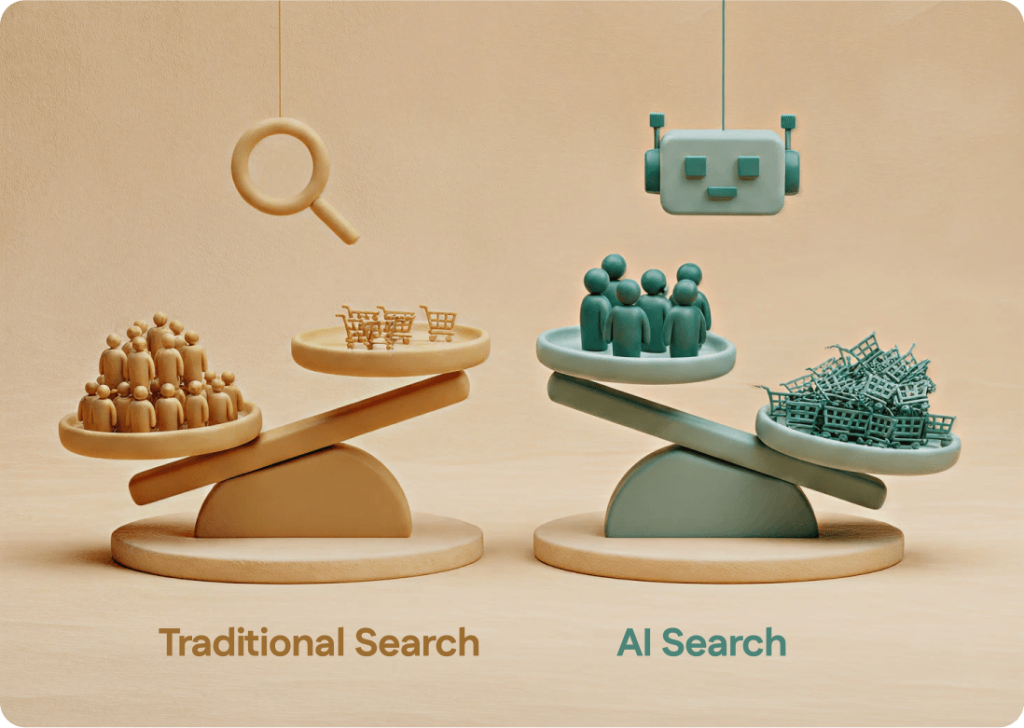
The last thing I wanted to touch on here, aside from the rapid growth and adoption of AI, is the quality of users you typically get to your website from AI vs traditional search.
We’ve seen across many clients that users from AI, although smaller in number than organic Google traffic, convert better.
The reasoning for this could be attributed to many things, but it’s usually because users of AI tools like ChatGPT spend more time talking to the LLM and asking questions about a particular product or service. When they eventually click through one of the sources or mentioned brands, they can be more informed and ready to make a purchase.
We’ll obviously take this with a pinch of salt – there are studies that indicate these users convert at a higher rate, but it’s extremely hard to quantify this – this is simply what we are hearing from clients we work with right now.
Google also agrees here.
Why Brand Mentions (And Backlinks) Are The Fastest & Easiest Way To Gain Visibility In The Era Of AI
The terms ‘brand mention’ and ‘backlink’ are quite vague, but for now, let’s just see why they are so effective for AI visibility – we can worry about the different types later.
If you build the correct type of brand mention or backlink, you will be able to get cited in AI engines within 1-2 weeks, reliably, for most of your top search terms.
It’s that simple. You can optimize your own website all you want with all the latest new tricks – and let’s be real, you should be doing this anyway – but building links/mentions opens up the opportunity to leverage literally millions of other websites.
The reason why it’s fast and easy is that you can directly target sources that are already used as citations in AI and get your brand featured – you can also publish articles on websites that are likely to be cited.
This probably sounds confusing right now, so let’s look at an example. I will also walk you through the three types of backlinks that work well for AI citations and why this is the case.
Brand Mention vs Backlink
A brand mention is simply when your brand is mentioned, whether that be on a guest post, an inclusion to an existing article (link insertion), or a feature on a media outlet through traditional digital PR.
A backlink, on the other hand, is a hyperlink to your website that can be dofollow, nofollow, sponsored, etc.
When we build links for clients, we cover both:
- We secure a dofollow link to help with traditional SEO
- We also include brand mentions positioned specifically for AI visibility
By focusing on both, we not only support existing SEO efforts (which also contribute to overall LLM visibility) but also secure quick wins for marketing teams with AI features.
So, when we refer to a backlink, we’re also including the brand mention under the same umbrella.
An Example Of How This Works
We work with lots of SAAS businesses, so let’s run with an example of a SAAS company that has a tool that allows users to use AI to help them build architectural designs.
Thinking like an SEO, this business would want to rank for terms like ‘Best AI Tools For Architecture’ and ‘Best Software For Architecture’, and so on.
What we would do from here is compile a list of all the keywords relevant to this business, and also take a snapshot of where their current keyword rankings were at, both in traditional search engines and AI.
We would then research across all AI engines to see if there were any existing sources that could be leveraged to either publish an article featuring our software or include our link in the article.
Things like:
- Existing listicles that rank the best AI architecture software tools & are highly cited in AI
- Authority websites in the AI or software niche that allow articles to be published
As you can imagine, there are lots of caveats to this process – it isn’t just simply publishing an article titled ‘Best AI Tool For Architecture’ on a random website and hoping it ranks.
In order to increase your success rate, you need to focus on three types of links and build the links in the right way.
Three Types Of Links That Work Well (And How To Build Them)
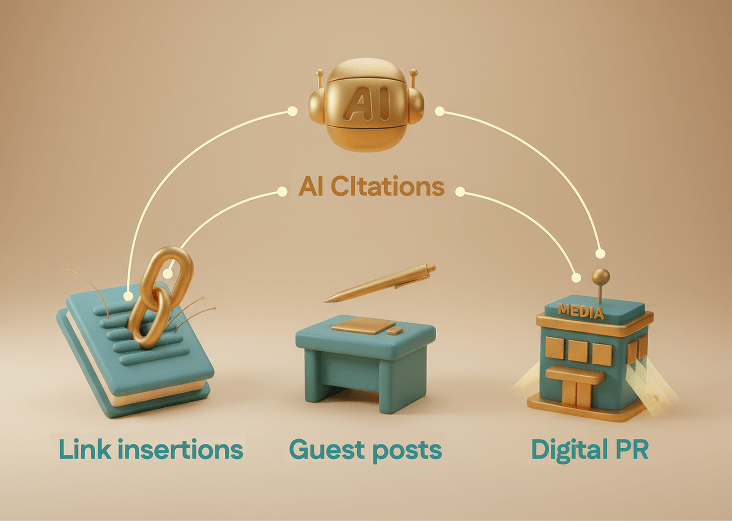
If you aren’t familiar with backlinks, they’re simply when one website links to another. In traditional SEO, backlinks help to pass pagerank to the target page and are built at scale to help websites rank for competitive terms.
This is still the case for the links below, but we optimize them for AI visibility as well. Funnily enough, this also leads to very high-quality links that are great for your usual SEO as well.
1) Link Insertions
Link insertions, or ‘niche edits’, have long been a part of any off page SEO strategy and one of the quickest ways to build links. A link insertion is simply when you add a link to an existing piece of content; that’s literally all it is.
As long as you target the right type of link insertions, these are incredible for AI visibility.
Obviously, we’re looking only for articles that are already used as a source in an AI engine, such as ChatGPT or Perplexity.
Like in our previous example, if there was a listicle that compared the best AI software tools for architecture and it was prominently cited across AI, this would be ideal for a link insertion and lead to very quick citations for the client.
2) Guest Posts
Guest posts involve publishing an article on another website, which includes a link back to your own site.
The quality of a guest post depends on many, many factors:
- Domain traffic
- Domain authority (How many links it has, and the quality of the links)
- Keywords the site ranks for
- Traffic history
- Outbound links vs inbound
- Spam score
- Niche relevancy
Every SEO has their own playbook for what guest posts are good, and which ones are bad – for the sake of simplicity, we’ll not do a deep dive into that here.
For now, we need to look at how guest posts can be beneficial for getting citations in AI.
To put it simply, our goal with guest posts for our clients is to publish on highly authoritative, niche-relevant websites where the guest post itself will rank for specific keywords and get traffic.
LLMs quickly crawl this type of content, and then use it for citations.
As you can imagine, there are lots of hurdles here:
- Choosing the right website is very difficult and requires experience with SEO
- Crafting content that gets cited is again very difficult
- Ensuring the link is built correctly also matters a lot – exact match anchors are not your friend here
Luckily for us, we’ve had the chance to test this across many websites with great success.
3) Digital PR Brand Mentions
Last, but certainly not least, is digital PR brand mentions.
These are the types of links where a brand is mentioned in an editorial piece of content that is published on a media brand website.
Think websites like Forbes, Business Insider, CNN, and so on.
It should be no surprise that these types of articles get cited a lot by AI – they are not only published on super authoritative websites that get millions of visitors per month, but they are also written professionally as well.
The secret to getting these links is forming relationships with journalists (there are many ways to do this) and then getting your brand featured.
This can be done by answering journalist queries on platforms like Qwoted or by having existing relationships with journalists through other means like affiliate partnerships.
It is also possible to get brand mentions naturally, but this isn’t something that can be relied on to happen often, especially for smaller brands with low visibility.
How To Test This On Your Own Website
So, why should you actually believe anything I’m saying?
With all the hype around AI, it makes perfect sense to be sceptical. My advice would be to test out building a link for your own website using the tips I mentioned above.
You don’t have to go out of your way to pitch an editor at the New York Times. Do a bit of keyword research, play around in ChatGPT or Perplexity, and figure out which relevant articles you can reach out to and negotiate a link placement with.
If you’re feeling extra confident, you could publish a brand new article on a high authority website with the goal of getting it cited in AI.
There is an art to negotiation and how much effort you’re willing to put into research and crafting the content or feature, but you will be surprised at the success rate if you put in the work.
On the other hand, you can implement an LLMs.txt file and watch as absolutely nothing happens. The choice is yours.
Is This Strategy Future-Proof?
Nobody can predict where AI will be in even a year’s time, never mind the future of AI and search.
All we know is that AI is likely to become more pivotal in search, and that it will rely on sources (mostly from Google’s index) to provide citations to its answers.
Building links that are focused on AI does a few things outside of just helping with AI citations:
- Supports traditional SEO efforts – remember that AI typically drives less than 1% of traffic to websites, although this is increasing rapidly. Building quality links that rank in AI supports traditional SEO and organic Google traffic, which remains the highest traffic source for a lot of websites.
- Increases brand exposure – Mentions on other websites mean a higher chance to be cited in AI, assuming the mentions are on quality websites.
- More mentions = more referral traffic.
A Quick Summary
To quickly recap:
- AI search traffic is increasing rapidly.
- There is a clear overlap between AI-friendly backlinks and backlinks that help websites rank highly in Google.
- Focusing on these types of links can quickly improve AI visibility for your brand, which can lead to highly converting visits.
- It also bolsters traditional SEO efforts.
If you want to see how quickly you can get cited in AI, we offer a $250 service where we’ll build one link and get it cited in an AI engine within 2 weeks, or you get your money back.

